0 items in your Shopping bag
Your cart changed
Confirm

Contact Us

book a visit

Location

Select country and language
Journal

Arco: The Flos Lamp That Brought the Ceiling Down to Earth

Designed by Achille and Pier Giacomo Castiglioni in 1962, the Arco floor lamp transformed a practical lighting problem into one of the most enduring icons of Italian design. More than six decades later, its sculptural silhouette continues to redefine the art of living.

October 2026
 |

There are design objects that furnish a room, and then there are those that fundamentally change the way we experience it. The Arco lamp, created by Italian designers Achille and Pier Giacomo Castiglioni for Flos in 1962, belongs firmly to the latter category. With its sweeping stainless-steel arch, polished aluminum shade, and monumental block of white Carrara marble, it does something that seems almost impossible: it brings the presence of a ceiling light into the room without ever touching the ceiling.

It is an elegant contradiction. A floor lamp that behaves like a pendant; an industrial structure that feels almost weightless; a functional object that has become a sculptural centerpiece in its own right. Long before flexible lighting became a familiar feature of contemporary interiors, Arco proposed a radically different relationship between architecture and illumination.

A Revolutionary Idea, Rooted in Everyday Life

The story of Arco begins not in a grand architectural gesture, but with an ordinary object: the streetlamp.

The Castiglioni brothers were renowned for their ability to observe the everyday world and extract from it unexpected design solutions. Rather than treating inspiration as something distant or abstract, they looked closely at familiar objects, questioning how they worked and how their principles might be translated into new contexts.

For Arco, the starting point was the streetlight: a source of illumination anchored to the ground yet capable of casting light over a considerable distance. The challenge was equally straightforward. How could a dining table be illuminated from above without installing a pendant lamp or drilling into the ceiling? The answer was a freestanding structure that could extend overhead while remaining entirely supported by the floor. In 1962, the brothers brought this idea to life through Flos, creating a lamp that would challenge conventional assumptions about domestic lighting. As the Museum of Modern Art notes, the design was conceived to illuminate the center of a table from a point several
feet away, without requiring a fixed ceiling connection.

It was a deceptively simple innovation, but its implications were significant. Lighting no longer had to be dictated by the position of an electrical outlet or the permanence of architectural fixtures. The light could move into the room, creating its own spatial logic.

 |
 |

The Architecture of a Lamp

At first glance, Arco appears almost impossibly balanced. A substantial marble base anchors a long, curving metal stem, which reaches outward before descending into a compact, rounded shade. The silhouette is instantly recognizable, yet every element has a practical purpose.

The base, carved from white Carrara marble, serves as a counterweight to the extended arch. The stainless-steel stem is telescopic, allowing the lamp's reach and height to be adjusted. At its end, a polished aluminum reflector directs light downward, illuminating a dining table, a reading area, or a carefully composed living room vignette.

Nothing is superfluous. The marble is not simply a luxurious finish; it is the structural foundation that makes the entire composition possible. The curve is not merely expressive; it creates the necessary reach. Even the small hole in the center of the marble block has a purpose: it allows a pole to be inserted so that two people can lift and move the heavy base more easily.

This attention to detail reflects the Castiglioni brothers' approach to design, in which ingenuity and practicality were inseparable from visual beauty.

Arco's brilliance lies in the way these functional decisions become its aesthetic language. Its engineering is visible, its structure is honest, and its proportions are architectural. The result is a lamp that feels less like an accessory and more like a carefully considered intervention in space.

Bringing the Ceiling Down to Earth

The true genius of Arco is not simply that it illuminates a table. It is that it changes the relationship between furniture and architecture. Traditionally, a pendant light belongs to the ceiling. Its position is fixed, its presence determined by the building's electrical infrastructure. Arco overturns that hierarchy. By transferring the supporting structure to the floor, it frees the light source to occupy the space above a table or seating area without requiring any permanent architectural intervention.

The effect is particularly striking in open-plan interiors, where the lamp can define a dining zone within a larger living space. Its curved silhouette establishes an overhead presence, creating an intimate sense of enclosure without the need for walls, partitions, or suspended fixtures.
In this way, Arco does more than illuminate a room: it helps organize it.

The lamp's scale is central to its success. Its expansive reach gives it the presence of an architectural element, while its slender profile preserves a sense of openness. Rather than interrupting a room's composition, it draws the eye through it, connecting the floor, the furniture, and the space above.
Few objects demonstrate so clearly how lighting can function as both a practical necessity and a tool for spatial design.

 |
 |

A Study in Material Contrasts

Part of Arco's enduring appeal lies in its carefully calibrated combination of materials.

The Carrara marble base introduces weight, texture, and a distinctly Italian material heritage. Its pale surface and natural veining lend the object a sense of permanence, grounding the otherwise fluid gesture of the arch. Above it, the stainless steel introduces precision and restraint. Its cool, reflective surface catches the surrounding light without competing with the room. The polished aluminum shade completes the composition, adding a compact, almost mechanical counterpoint to the sweeping curve.

The contrast is essential: solid and slender, grounded and suspended, monumental and minimal.
Arco does not rely on ornament to establish its identity. Instead, it draws its character from proportion, material, and the tension between its components. This is what allows the lamp to feel at home in such different environments, from a restrained modernist interior to a richly layered apartment filled with art, vintage furniture, and collected objects.
It is also why Arco photographs so beautifully. Its silhouette remains legible against different architectural backdrops, while the marble and metal introduce subtle variations in texture and light.

How to Style the Arco Lamp in a Contemporary Interior

For all its sculptural presence, Arco is remarkably adaptable. Its success in a room depends less on matching its materials to the surrounding furniture than on allowing its proportions to work.

Over a dining table. 
This is perhaps the lamp's most natural setting. Positioned beside a dining table, Arco creates the effect of a pendant without requiring a ceiling installation. It works particularly well above a rectangular table, where the arch can extend over the center while leaving the surrounding space visually open.

Beside a low-slung sofa. 
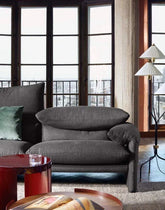
In a living room, the lamp can establish a reading or conversation area while introducing a strong architectural line. Pair it with understated upholstery and a restrained palette to emphasize its silhouette, or place it among expressive furniture and artworks for a more eclectic composition.

Against a textured backdrop.
White marble and polished steel take on a different character beside limewashed walls, warm timber, natural stone, or richly colored surfaces. The contrast between the lamp's industrial precision and the tactile quality of its surroundings creates visual depth without requiring additional decoration.

As a sculptural focal point. 
Arco is a statement piece, and it benefits from breathing room. Avoid crowding its base with too many accessories or allowing the arc to compete with multiple oversized objects. Its form is most effective when it can be read clearly from across the room. The guiding principle is simple: treat Arco not as a finishing touch, but as an integral part of the interior's composition.

Thanks for subscribing