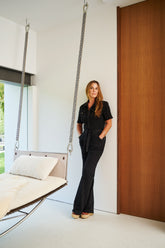
Sophie Goineau, French-Canadian interior architect and designer, discusses with Interni and Luminaire her holistic approach to design, where objects, interiors, architecture and landscape come together.
Your approach to design is rooted in environmental design. What does that mean to you?
My approach is grounded in environmental design and, more specifically, in the relationship between different scales. It moves fluidly from the object to furniture, from interiors to architecture, and ultimately into the landscape and the broader context.
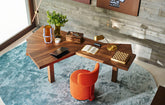
I do not experience those as separate territories. I am interested in how they participate in the same composition, and particularly in what the eye perceives as it moves through space. A piece of furniture is never simply an object placed within a room. Its scale, proportion, materiality and position establish a relationship with the interior architecture around it, with light, with an opening, with another object at a different depth, and sometimes with the landscape beyond. The work is therefore constantly moving between scales, from the intimacy of an object or a piece of furniture to the larger architectural gesture. Each decision participates in something larger. When those relationships are resolved, the individual elements begin to belong to one continuous experience.
What connects these different scales?
"What connects them is relationship. We think very consciously about scale, proportion, materiality, rhythm, light and depth, and about how the eye moves through successive planes.
There is also a human dimension to all of this. Whether we are considering an object, a piece of furniture, an interior or a much larger architectural volume, ultimately the environment has to relate back to the person inhabiting it. Materiality, texture and light are fundamental because they create continuity, but also emotion and memory. The relationship between interior and exterior is equally important, not as an isolated idea about landscape, but as part of the larger composition. Architecture, interior architecture, furniture, art, objects and landscape are all perceived in relation to one another.
Ideally, you experience the whole before you begin to isolate the individual decisions. There can be a great deal of thought behind each element, but when the relationships are right, they begin to feel natural and coherent rather than separate gestures."


Does place influence the emotion a space can convey?
Absolutely. Context is fundamental. Wherever we work, every place carries its own conditions, its own architecture, landscape, light, climate, culture and way of living. All of those things contribute to the emotional character of a project and become part of what we respond to. For us, however, the starting point is always the people. We begin by understanding who they are, how they live, what they respond to and the particular energy they bring to a place. From there, we begin to understand the architecture and its context, and the language of the project develops through those relationships.
Each project therefore has the opportunity to develop its own visual and material language. Materiality, texture, light, furniture, art and objects become part of interpreting that particular relationship between the people, the architecture and the place. The way we think and compose remains consistent, but its expression can be completely different from one project to another. I think that is what allows a project to feel deeply personal and intrinsically connected to where it belongs. Its identity and emotional resonance emerge from those relationships rather than from a predetermined aesthetic.


What projects are you currently working on?
We are in a very exciting and active period at the studio, with several new residential projects underway in Northern California, including homes in Los Altos Hills, alongside the complete reconstruction of a residence in Malibu. I am also designing a lake house in Quebec for my family, and there is a potential new opportunity developing in Miami for the fall.
What is particularly exciting is how different the conditions are. The sites, topographies, views, architecture, climates and ways of living vary enormously. Our way of thinking remains consistent, but each project develops its own language through those particular conditions and through the people who will inhabit it.
There is also a continuity that often develops beyond the principal completion of a home. Our relationship with clients can continue as they inhabit the space and the environment evolves with them. Art, objects and individual pieces may be discovered and introduced over time. The core of the project is resolved, while these more personal articulations can continue to grow with the life of the home. I value that ongoing relationship very much.
How does your collaboration with Interni and Luminaire support your work?
What is particularly valuable to us is that Interni and Luminaire give us access to an extraordinary global design network while still maintaining a very personal relationship with our studio.
Our work moves constantly between scales, from an object or a piece of furniture to lighting, materiality and the larger interior architectural composition. Having access to such a broad international network of manufacturers, collections, materials, finishes, technical knowledge and craftsmanship gives us an enormous vocabulary with which to work. We can explore what is truly right for a project rather than beginning from a limited field of possibilities.
Furniture has a very important role in our work. It participates in scale, proportion and rhythm, and in the way the eye moves through a space. The same is true of lighting and objects. They are part of the composition, so access to that breadth of design, material and technical possibility is extremely valuable. But access alone is not enough. What makes the relationship particularly important is the service and the people behind it. There is an enormous amount that happens between identifying the right piece and successfully integrating it into a project: materials and finishes, dimensions, customization, technical information, coordination with manufacturers, procurement, logistics, delivery and installation. Having a team that understands the design intention and can support that process gives us continuity from the creative decision through realization.
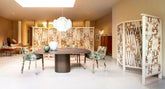
Selby Lane was a very good example of that relationship. The collaboration with the San Francisco team was fluid, accessible and personal. We had continuity of dialogue and support throughout the process, and that allows us to remain focused on the intention of the project while knowing there is an experienced network behind us helping us carry it through. For me, the most valuable collaborations are based on exchange. We bring our vision and our understanding of the project, and they bring an extraordinary knowledge of their manufacturers, materials, capabilities and resources. Through that dialogue, we can discover possibilities, refine decisions and sometimes arrive at solutions we would not have reached independently.
Ultimately, it is not simply access to beautiful furniture or objects. It is access to knowledge, people, craftsmanship, technical expertise and service within a global network. That combination is what makes Interni and Luminaire such an important resource for our practice, particularly as our work continues to expand across different locations and contexts.